Bringing AI to Wealth Management
In the summer of 2024, Mark Swan, an aspiring founder and former operations lead at Revolut, came to two realizations. The first was that service businesses would be the biggest benefactors of AI, with AI-powered tools helping to streamline operations and offload administration-intensive processes. The second was that one of the sectors with the greatest need for tools to support these tasks was the financial services industry, particularly wealth managers.
Swan recognized financial advisors faced an “80/20 problem.” They spent 80% of their time on administrative work, leaving only 20% for time with clients navigating significant, often emotional, financial life decisions, from saving for retirement to paying for their children’s education. Meanwhile, the demand for financial advice was accelerating. As of 2024, the number of affluent households in the U.S. with more than five hundred thousand dollars in investable assets was growing eight times faster than the population. But with such large administrative workloads, Swan learned, wealth management firms suffered an inability to scale and serve more clients. And the current tools for assisting with their administrative overhead weren’t cutting it.
From his research, Swan developed a third realization, this one contrarian. While many predicted tools for AI would replace human roles in the financial services sector, Swan believed the opposite: that in a world increasingly dominated by AI, human-led advice would become all the more important.
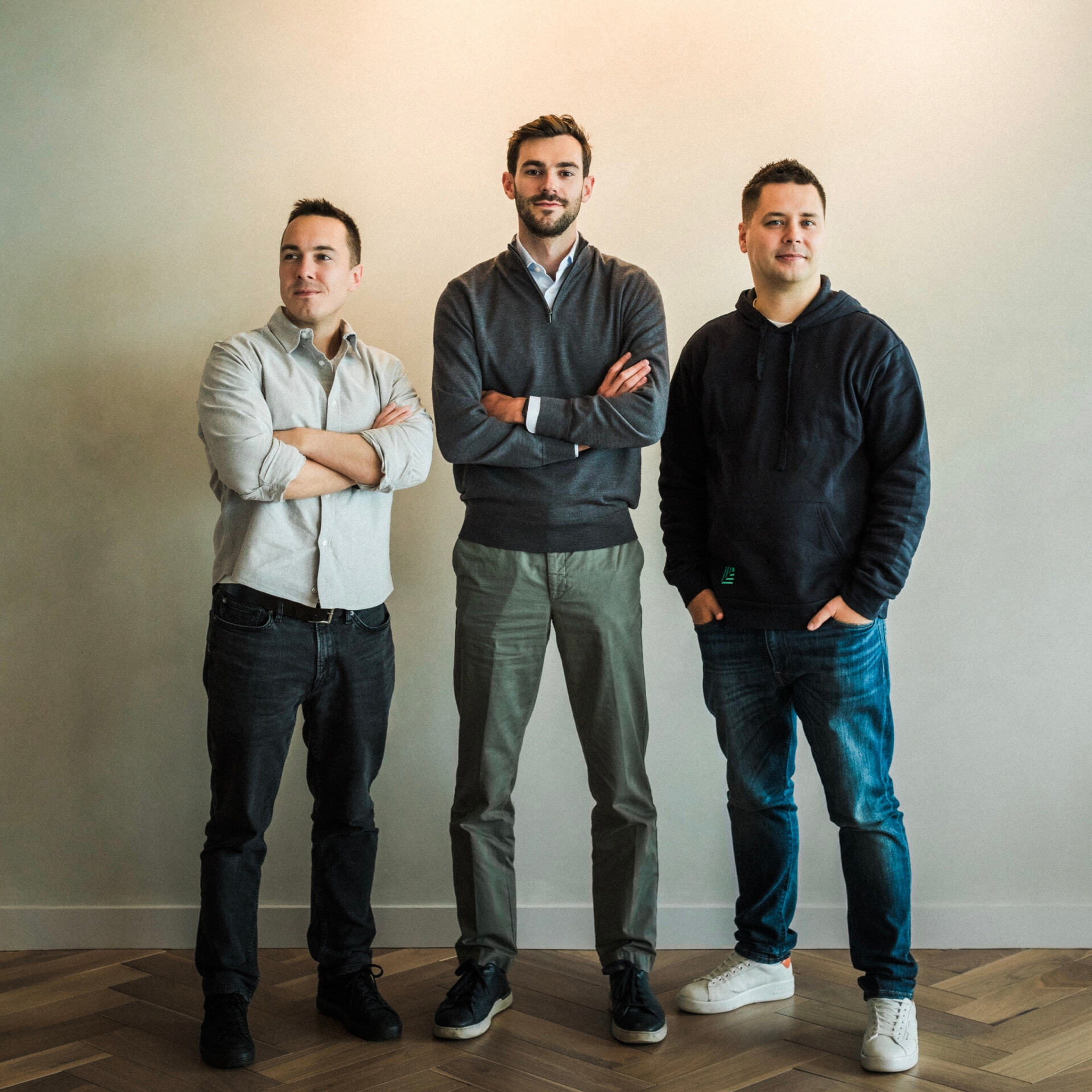
Fast forward to today — Nevis is a New York City-based AI platform for Registered Investment Advisors. Founded by Swan (CEO), Philipp Burda (CPO) and Ivan Chalov (COO), Nevis came out of stealth in early December. The company raised a $5 million seed round from Sequoia in 2024 and a Series A of nearly $35 million from Sequoia, ICONIQ and Ribbit Capital in 2025, bringing its total funding since inception to $40 million. Nevis’s thesis is simple: AI won’t replace financial advisors, but it can turbocharge them, offering tools that give wealth managers 80% of their time back. This will allow them to have deeper and more meaningful relationships with clients and enable them to scale to serve more people. Nevis’s rapidly growing customer base currently includes some of the fastest-growing wealth management firms in the U.S., collectively overseeing more than $50 billion in client assets.
Swan, Burda and Chalov first crossed paths at Revolut. Burda rose through the ranks as head of fincrime, then head of data science for the retail product, and, finally, partner and head of Revolut’s GenAI product initiatives. Meanwhile Chalov ascended from data scientist to general manager of retail business at Revolut. In their three years of overlap, the co-founders’ professional alchemy flourished. “We were absolutely smashing in terms of coming up with ideas, approaches, shortcuts and all these tricks,” Burda says. “I was very impressed by Ivan, how hardworking he is and logical at the same time. And Mark, I was blown away by the things he was doing and the quality of his work.” When Swan left Revolut in the spring of 2024 to pursue his own venture, Burda and Chalov encouraged him to stay in touch in case there was an opportunity for further collaboration.
Swan’s drive to bring meaningful change to an industry dates back to his childhood in Aberdeen, Scotland. His initial goal, however, was to become a politician. “I always knew I wanted to do something that would have the biggest impact on the world,” Swan says. “At the time, I felt the way to do that was through politics.” Swan rigorously plotted his course, diving into books and excelling in school — achieving more A-levels than any other Scottish student at the time.
Meanwhile, across the globe, Chalov’s and Burda’s fathers were fanning the enterprising flame in their own sons. “My father is an entrepreneur who tried everything: running a computer hardware store, owning a local newspaper, selling cars, even running a duck farm,” says Chalov, reflecting on his childhood in Akademgorodok, a small research town in Siberia. Meanwhile, Burda’s Russian physicist father was taking a more direct approach in encouraging a problem-solving spirit in his son — handing him books on HTML and math puzzles anytime they went on a car ride. Burda’s first stab at company-founding was at 15, when he started a short-lived web design agency with friends. He spent the next decade in academia, while Chalov worked as a trader at an investment bank, before both shifted industries to join the ranks at Revolut.
Swan was the last to arrive at Revolut. Before leaving for university, he had spent a year as an intern with Al Gore’s Generation Investment Management — an experience that opened his eyes to the potential of changing the world through business and technology. Following graduation, he pursued work in this space. His first official day in the Revolut office, however, began with a whimper. Swan showed up in the summer of 2021, excited to be in-person among co-workers after the pandemic’s remote era, only to discover an empty floor. He searched for his assigned line manager, but that person was nowhere to be found. Halfway through the day, after working alone for a number of hours, a man approached and asked his name. When he replied, “Mark Swan,” Chalov stuck out his hand. He informed Mark that the line manager in question no longer worked there; Swan would now report to him. “I wanted to join Revolut because I knew it was going to be like a rocket ship,” Swan says, “and I was going to learn better there than anywhere else. Just go drink from the fire hose. That was exactly my experience.”
Around this time, unbeknownst to Swan, his name went on Sequoia’s list of “prefounders” to keep an eye on, thanks to Edward O’Carroll, a former talent lead at Sequoia. “We have a term called ‘dynamo’ at Sequoia for people who are slightly earlier in their careers, but we would describe them as very high slope in terms of their rate of evolution,” says George Robson, a partner at Sequoia who wrapped up his own time at Revolut in 2020. “Mark was put on this list for exactly that reason — he was a ‘dynamo.’”
In the months after leaving Revolut, Swan heard repeatedly from those across service businesses that while a storm of startups offering AI-powered tools was emerging, the actual delivery of those promised products was falling short. “In a lot of professional services markets, like wealth tech, for example, you have AI companies who don’t fully understand that industry and how to build proper product solutions, but who are trying to sell the dream saying, ‘We’ll create an army of digital workers, which will work for you 24/7,’” explains Burda. “Realistically, those companies that don’t know how to build robust AI-native products in a regulated environment will have their products delayed and delayed. Advisors are being burned by false propositions, and customers lose trust in those companies, plus they’re missing out on proper tools that can help them now.”
As Swan zeroed in on an AI platform for wealth management, he identified trust as a key pillar of what would ultimately become Nevis. He also recognized that his deep experience building cutting-edge AI products at scale in financial services during his time at Revolut was a core differentiator. It would give customers confidence in his product and set his company apart.
In an act of shrewd business strategy with a dash of kismet, around this time Edward O’Carroll brought Swan’s name up to Sequoia partners Robson and Luciana Lixandru as a potential investment. “We had a meeting with Mark in our office,” Lixandru says. “I remember thinking, how is he 26? He’s just mature way beyond his years. He’s so accomplished, so ambitious, and has so many outlier characteristics. I had forgotten the feeling of meeting a founder and just knowing on the spot that you want to back them. That happens once a year, where you have an ‘aha’ moment right away.”
The seed investment from Sequoia happened swiftly in September 2024, almost as if Swan had manifested it. Swan admits he’s a closet “manifestor” — his favorite method is to write something down on a piece of paper and will it into existence. In this case, the piece of paper that he scribbled on the day he left Revolut, which he still keeps to this day, says he’d have seed money by the time he went to his parents’ wedding anniversary that fall. Sure enough, Swan found himself boarding a flight to Aberdeen, feverishly crunching numbers as he stepped toward the jet bridge. “I remember vividly trying to do the mental maths in my head. I’m trying to work out, is this deal good? Is it not good?” Swan recalls. The partnership was formalized, and, shortly thereafter, Burda and Chalov left Revolut to co-found Nevis with Swan.
Armed with a seed investment, the trio doubled down on understanding pain points within the wealth management sector, speaking at length with financial advisors to learn more about the 80/20 problem. Above all, what they heard repeatedly was that financial advisors valued their relationships with clients and that clients put enormous trust in their financial advisors — trust they didn’t want to cede to AI.
“People don’t want robots telling them how to manage their life savings,” says Swan, who has a personal connection of his own to financial advisors — or rather, a memory of the absence of one that gives him a perspective on their value. “Growing up, my parents did most of their investing themselves,” Swan says. “They weren’t in a position to have an advisor because the cost was too high. One of our goals with Nevis is to reduce the cost to serve, so advisors can support more clients and open access to high-quality financial advice for millions of people who don’t receive it today.”
Their business soon took shape. The co-founders created an AI “system of action” for financial advisors to reduce hours spent manually inputting data, updating records, and searching for information across fragmented systems. Unlike its point solution competitors, Nevis intentionally started with a more holistic product that can automate workflows end-to-end. Its platform connects to clients’ CRMs, email and messenger apps, and document storage systems, pulling from this data to assist in meeting preparation, to generate reports on investment performances and to maintain or make changes to clients’ accounts.
Confident in their product, the Nevis co-founders approached their Sequoia partners with a go-to-market plan centered on the U.K. Robson and Lixandru challenged them, however, to look at other, larger markets where AI is more rapidly being deployed. The trio eventually came to the conclusion that the U.S. had the same banking woes and pain points as the U.K. but was culturally ripe for this type of innovation.
To win customers’ trust, Swan and his co-founders prioritized in-person meetings, even if it meant traveling long distances, both to demonstrate the value of Nevis and also to build meaningful connections with those using the product. For United Capital, Swan flew to Newport Beach, California, discovered that Jim Rivers, the company’s president, loved to surf and turned one coffee meeting into a multi-day affair. For Apollon Wealth Management, Swan flew to Tampa and drove four hours to Miami for a thirty-minute sit-down with COO Brad Goodman, which evolved into a multi-hour strategy meeting, ultimately landing Nevis yet another customer.
Even after winning clients, Swan continues to regularly sit down with firms in person. “It’s beyond being on a first name basis,” says Robson. “By actually going and frequently spending time with clients, Mark is able to earn a very high level of confidence.”
Nevis’s decision to come out of stealth mode is a result of the momentum it’s seeing in the U.S. “We have enormous market demand,” Swan says, “and what’s more, we have validation from current customers around the strength of our product. We felt now was the time to bring this platform that we know is extremely valuable to a larger market.”
Nevis is rapidly growing its headcount, as it focuses on scaling and building new products. It continues to attract those who cut their teeth at Revolut; many of Nevis’s current employees, like its co-founders, are alumni of the company. Swan, Burda and Chalov recognize that people — from the internal team at Nevis, to the wealth management firms that use their product, to the clients depending on trusted advisors for wealth management — are the key to the company’s success. The founders are direct with each other when making decisions and direct with their clients when tackling their needs. Most importantly, Swan, Burda and Chalov know that to harness AI effectively, it needs to be developed through the exacting lens of tools and processes that can deepen trust amongst humans in the workplace instead of erasing it.